
Perfect 10 Day Croatia Itinerary for First-Timers
Between its stoney old towns, terracotta tiled rooftops, and glowingly-blue waters – what’s not to love about Croatia? This beautiful little country in southeastern Europe boasts so much to see, that it’s difficult to create an itinerary for a limited amount of time. But for a first-time visit, I think ten days in Croatia is ideal in order to see the best of the country plus make some really cool side trips into bordering countries. That’s why I put together this ten day Croatia itinerary.
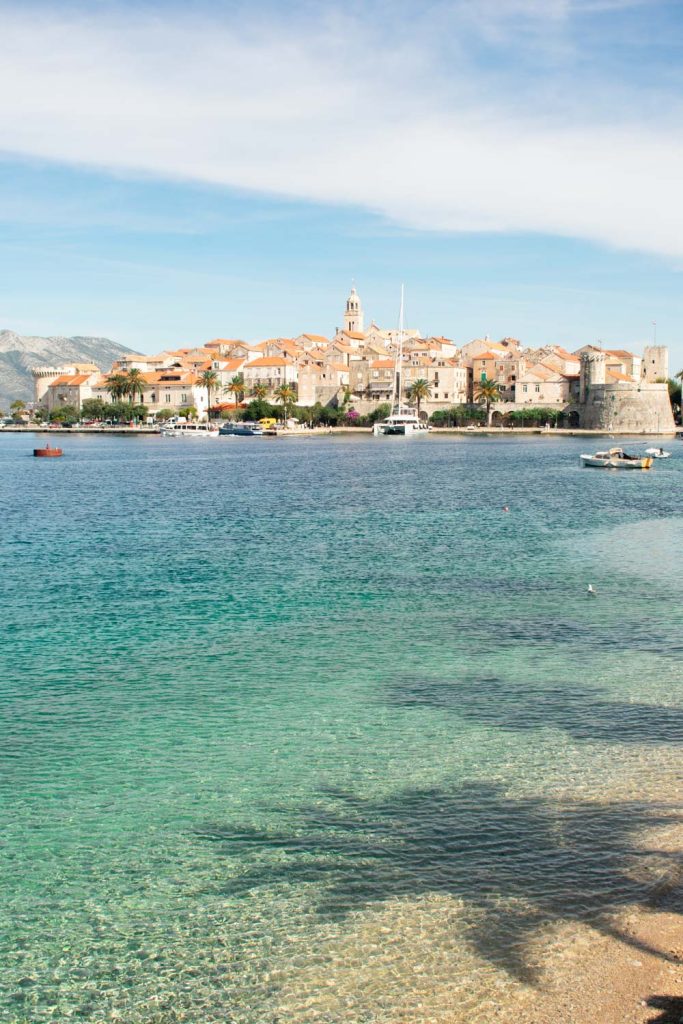
On my own first visit to Croatia, I was so unsure about what to include and exclude in my itinerary, or even what airport to fly into and out of. But now that I’ve visited Croatia multiple times, and in an effort to take the guesswork out of it for others, I’ve put together this epic ten day Croatia itinerary for first time visitors. With this seven day Croatia itinerary, you’ll enjoy towns, beaches, and waterfalls – the three things Croatia is most loved for.
Now, I have to warn you. This ten day Croatia itinerary is super detailed. Like, okay-but- how-do-you-have-time-to-write-all-this detailed. And I did that on purpose. You can go to any old website to get a vague “two nights here” and “one night here,” bare-bones itinerary for Croatia. But those itineraries don’t tell you what to do in each destination, or what order to do these things, or how to get from each city to city. You’d have to go look all that up separately. But not with this itinerary.
What I’m trying to say is: this is a jam-packed read. So if you don’t think you’ll finish it all in one go, you might want to save this article for later right now by bookmarking it or saving it on Pinterest. Then, grab a cuppa, kick your feet up, and let’s get to it!
Psst! If you’re debating a shorter trip, be sure to check out my Croatia itinerary for one week.
Croatia Ten Day Itinerary Summary
First, let’s start off with an overview of this epic, ten day Croatia itinerary, so that you can have a general idea of what to expect.
On a first-time visit to Croatia, I recommend spending a good chunk of time on the coast. Almost all of your time, honestly! Croatia is most known for its coastline, after all. More specifically, I recommend focusing on the Dalmatian Coast. This area is home to Croatia’s biggest draws; Dubrovnik, Split, and Hvar. But don’t worry! You’ll still be able to squeeze in the biggest non-Dalmatian-Coast draw, plus two gems in neighboring countries, via day trips.
| Days | Destination | Overnight In |
| Days 1 – 2 | Split | Split |
| Day 3 | Plitvice (or Krka) Park | Split |
| Day 4 | Hvar | Hvar |
| Day 5 | Island Hopping | Hvar |
| Day 6 | Korcula | Hvar |
| Days 7 – 8 | Dubrovnik | Dubrovnik |
| Day 9 | Mostar | Dubrovnik |
| Day 10 | Kotor | Dubrovnik |
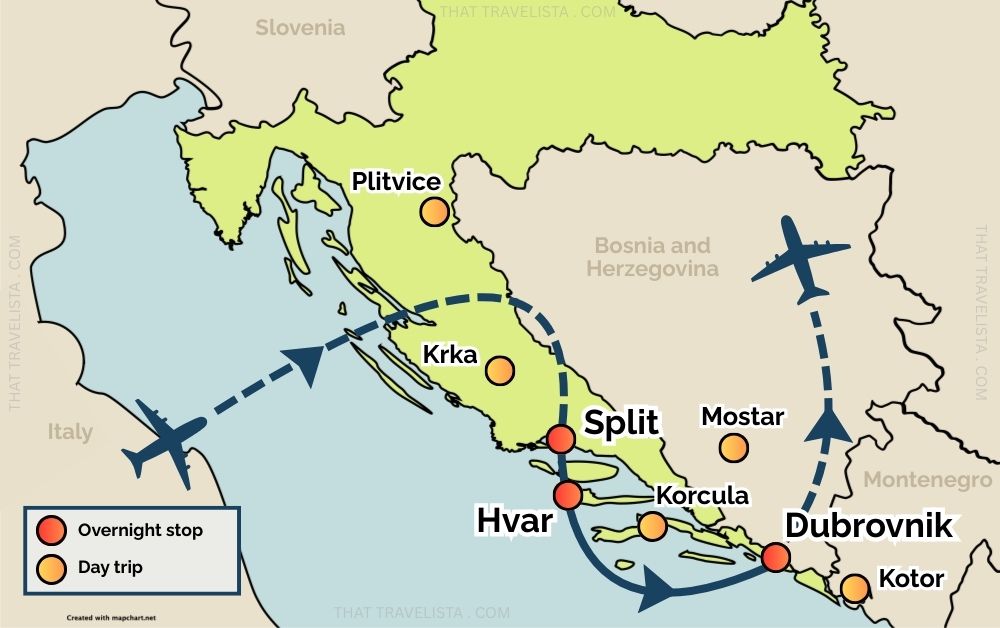
And finally, in case you’re a visual person (like I yours truly!) I’ve made this nice little map of your ten day Croatia itinerary route. I hope you’re starting to get pumped, now that you can visualize the unreal Croatia vacation you’re about to have!
The Best Time of Year to Travel to Croatia
Because this itinerary (and most every Croatia itinerary) focuses on the coastline, the best time to visit Croatia is of course during warmer weather. Specifically, I recommend visiting Croatia in the shoulder seasons of late May – mid June and September – early October.
This allows you to enjoy everything in pleasant weather, but helps you avoid the extreme crowds that some cruise-ship cities like Dubrovnik experience in the summer. It will also help lower the costs for your hotels and excursions by a bit. Aiming for September – October in particular allows the waters all summer to get warmer, so keep that in mind if swimming in the sea is a priority for you. But the Adriatic Sea is definitely more-than-bearable by even early May, from my experience.

I personally have experienced Croatia in early May, mid September, late September, and early October. So if you have any questions on visiting Croatia during those times of year (or any questions in general, really), feel free to drop me a comment in the comment section at the bottom of this post. And yes – I actually do respond.
Jump straight to the start of the itinerary here.
The Best Way to Travel Around Croatia
Unlike Italy across the way, Croatia is not an easy country to travel by train. So, you will need to either rent a private car or stick to public buses and ferries.
Renting a Car in Croatia
Car rentals in Croatia are actually rather affordable. But this is less true if you aren’t renting a manual transmission (i.e. stick shift) car. So, given that yours truly hails from the U S of A, and due to that only knows how to drive automatic transmission, I haven’t rented a car in Croatia.
On my first trip, I was pretty sad about this. Seeing how cheap car rentals were (especially back then, before Croatia was as popular of a destination) made me really wish I was renting one!
But in retrospect, and especially for a ten day Croatia itinerary that hits the main spots, like this one is, a car truly isn’t necessary. Why?
- You need to pay more for ferries to be able to take the car onboard.
- You need to plan things out more to top up on gas and find parking.
- There are going to be a lot of days where the car just sits in the parking lot doing nothing, because this itinerary doesn’t have you moving around every day from your base city.
- This itinerary has you crossing a couple borders, which complicates car rentals a bit more.
Thus, this 10 day Croatia itinerary guides you through the country solely using buses and ferries. I include alllllll the details you will need, like the bus and ferry station locations, the prices, websites to book, and travel duration for each time you’ll use public transport to move around Croatia. I’ve got you covered!
But you can absolutely still do this exact same itinerary with your own car rental, if you really want to.
Traveling Croatia by Bus
I have to admit that I was pleasantly surprised at how clean, comfortable, and free-WiFi-offering buses in Croatia are. So if you’re a bit saddened to learn that you won’t be using trains to move around, don’t be. The buses you’ll be using in this itinerary aren’t public city buses, but rather large, private coach buses.
The only thing that can be a little confusing about traveling via bus in Croatia is where to buy your bus tickets if you want to buy them in advance online. The routes are run by various private companies. Many of them don’t have their own website to purchase tickets online, so you have to use a third party site to look up timetables and purchase tickets. So I personally use Flixbus to purchase bus tickets in advance in Croatia, since it is an international company we’re all used to using within Europe.
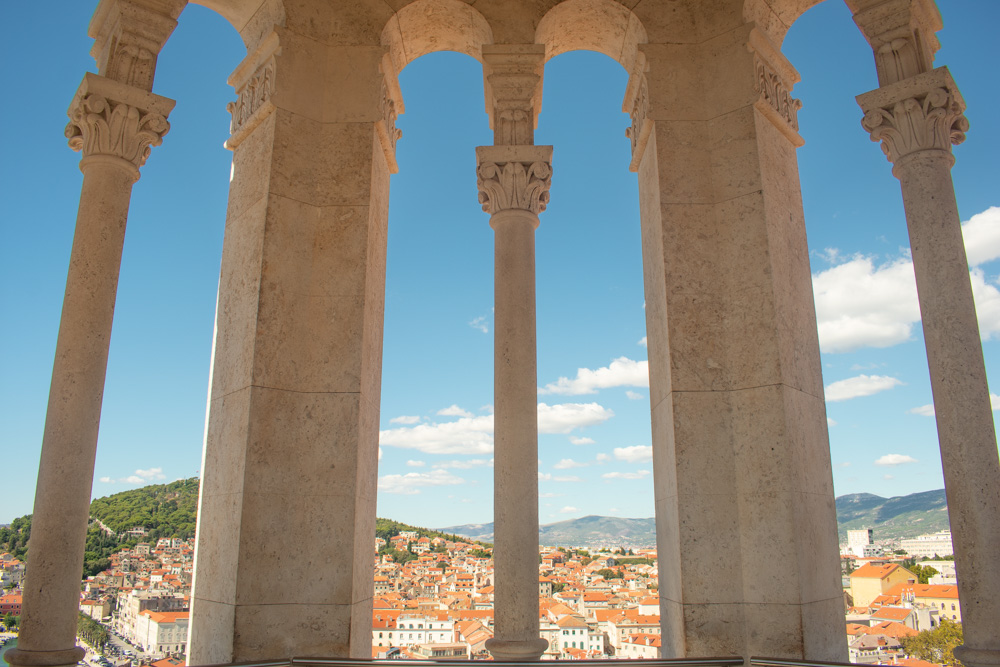
Sometimes Flixbus is actually the one operating the bus route. In that case, it is of course a no-brainer to purchase directly from them. But if the route is operated by a local company, purchasing on Flixbus will cost a bit more than on various other third-party sites. I personally think it’s worth it, in order to just have all tickets purchased on one reputable site that you are familiar with and to be able to manage all purchases in one place via their app or site.
But if you are traveling outside of high season, or if you are in a destination multiple nights to be able to purchase bus tickets at least a day or two in advance of your journey, then purchasing in person is always an option, too. I had no problem paying by credit card for this during my most-recent trip to Croatia.
Using Ferries in Croatia
Ferries are my personal favorite way to travel in Croatia! You have so much room to move around, you get to enjoy fresh air and great views from the deck, there are food and drinks for purchase, and the toilets are much more comfortable to use than those in a bus (if your bus even has toilets!).
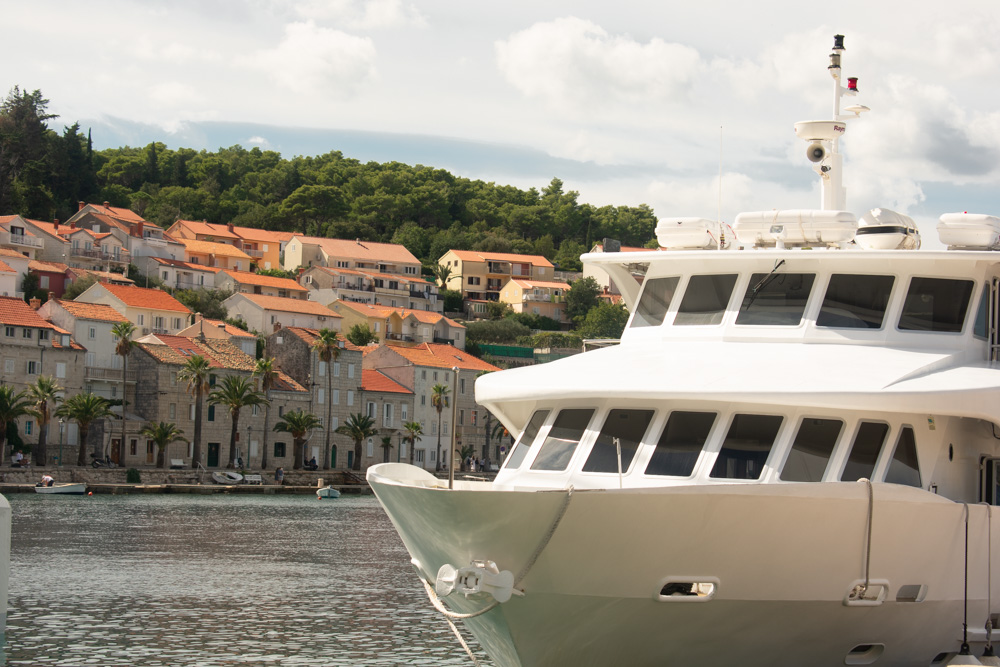
On my first trip in Croatia, we were able to just waltz up to the ticket booth, ask what time the next ferry to our destination was, and buy a ticket for that next ferry. But on my latest visit – which was still in shoulder season, mind you! – I could see certain ferries selling out the evening before while I was checking the timetable for the following day. So I can imagine that in high season, tickets for the most convenient times would sell out even earlier. Because of that, I recommend that you buy your ferry tickets one to a few days in advance, depending on the time of year that you are visiting.
There are various companies operating different types of ferries around Croatia. So what I like to do is use a website like this to get an overview of what ferries are running each day. Then, I go to the website of the specific ferry company itself (like Jadrolinija or Kapetan Luka) to actually book my ticket.
Just like when traveling Croatia by bus, purchasing in person is also an option if you are traveling outside of high season or staying in a destination multiple nights to be able to purchase tickets earlier than your travel date. Again, you can make these purchases by card.
Money in Croatia
Next, let’s talk about money in Croatia, because lemme tell ya – there is quite a bit of outdated information out there!
Croatian Currency
Croatia is obviously in Europe. It is also in the EU. But for many years, it was not part of the Eurozone nor the Schengen area. But as of January 1, 2023, that has changed! Now Croatia’s currency is the euro, not the kuna. And now, the days you spend in Croatia will count towards your 90 visa-free days* in the Schengen area per 180 day period, if you come from a country whose passport allows that. If you don’t, Croatia now is included in the area you can travel with your Schengen visa.
* This means no more hanging out in Croatia as part of time to reset your Schengen days. *sheds tear*
Credit Cards vs Cash in Croatia
Credit cards are accepted in Croatia by hotels and by many restaurants, but it will be limiting to go through the entire ten days in Croatia without using cash. So, you definitely will want to have some euros on hand in Croatia. This will be how you pay for any smaller attraction entries, bus rides that you purchase on board, and meals in certain restaurants.
Is Croatia Expensive? Is Croatia Cheap?
Croatia has had the reputation of a budget travel destination for some years. It was a European destination that was considered off-the-beaten-path, and the prices relating to tourist activities reflected that. It also used to help that Americans and Euro-zone-country visitors faced a favorable exchange rate for kunas.
But in recent years, Croatia is becoming more and more popular to visit. And like I mentioned above, it now uses the euro.
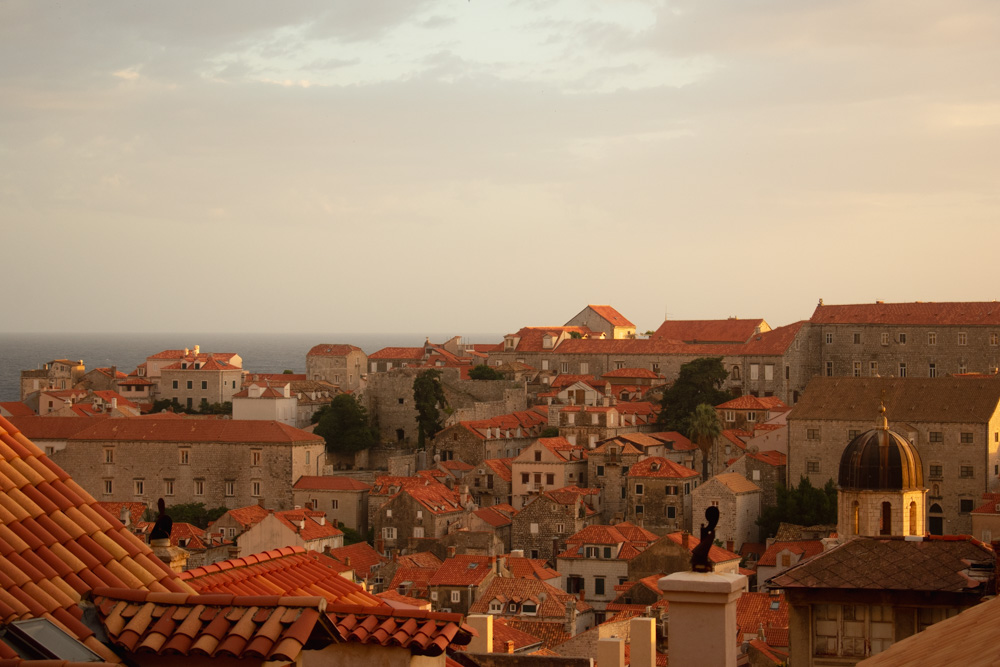
Thus, its travel-related costs are rising quickly relative to its neighboring Balkan countries. Croatia is not “cheap” like it used to be, at least in the popular destinations making up most itineraries, and especially in Dubrovnik.
That being said, I still would not necessarily classify Croatia as expensive, minus Dubrovnik. Dubrovnik gave me sticker shock on my latest trip! I can’t believe the prices nowadays. But it just goes to show how attractive of a vacation destination Croatia is. People just didn’t realize it before!
What to Pack for Croatia
This is a question I get asked a lot for any place I write about. My answer is always that it depends on weather. So recommend that you search “[city name] monthly weather” on Google to get an idea while you’re choosing the dates for your trip.
Then, the week before your trip, check the weather forecast on your weather app for the cities you will visit. You never know when a destination will get a record-breaking heat wave or a stormy week. So it’s best to have up-to-date forecasts before you pack, rather than just going off what your friend’s experience was last year.
But assuming you will have lovely weather, there are a few items I want to make sure you pack!
- Water shoes: Most of the swim spots you will have access to following this itinerary will be pebbly or even rocky beaches. So pack along a pair of water shoes to avoid any cuts to your feet!
- Sunscreen and hat: Between exploring the tree-less old towns, the water excursions, and laying out on the beach you will be in the sun a lot! So pack a sunscreen that you don’t hate, as well as a hat that you don’t mind getting wet or being photographed in.
- Goggles: You’ll want to see all the cute little fishies! The water is so clear in Croatia, especially on the islands.
- Dry bag: If you have valuables that you want to take on boating trips, consider investing in a 5L dry bag. (You could also get a 10L one, if you want to use it for hikes where it might rain.) I always take my 10L on my beachy destinations, since I’m often solo, so that I can leave my things close by (aka, prone to getting wet) while I am in the water.
- Waterproof phone pouch: This is another lifesaver for when I travel solo. I use a phone pouch (sized larger than the size of my actual phone) to fit my phone, a credit card, a bit of cash, and my hotel key. Then, I can just wear its lanyard over my shoulder or around my neck while I am in the water. This way, all my I-would-be-screwed-if-this-were-stolen items stay on me at all times, while my not-so-important items (like snacks, my towel, etc.) stay in the dry bag on shore or in the boat.

Other than that, just dress comfortably, especially when it comes to shoes. And bring options to dress in layers, so that you can adjust as the temperature rises and then falls throughout the day. Oh, and don’t bother trying to “look like a local” – we all stand out as tourists because, well, that’s what we are!
Language in Croatia
For this Croatia itinerary, you will have zero issue getting by on English. But it’s never a bad idea to have the Google Translate app (iPhone and Android) ready to go with Croatian downloaded in offline mode.
(Finally) The Actual Croatia 10 Day Itinerary
Beforehand, I just want to remind you that you can do this Croatia itinerary in the order I have it or the exact reverse order. Just look up flights and see which direction offers better flights from your airport.
Also, at the very end of this guide, I have a section on how to tweak this itinerary to fit your personal interests and situation. And if you still have more questions, just leave me a comment in the comment section at the very bottom. Ready? Then let’s go!
Split
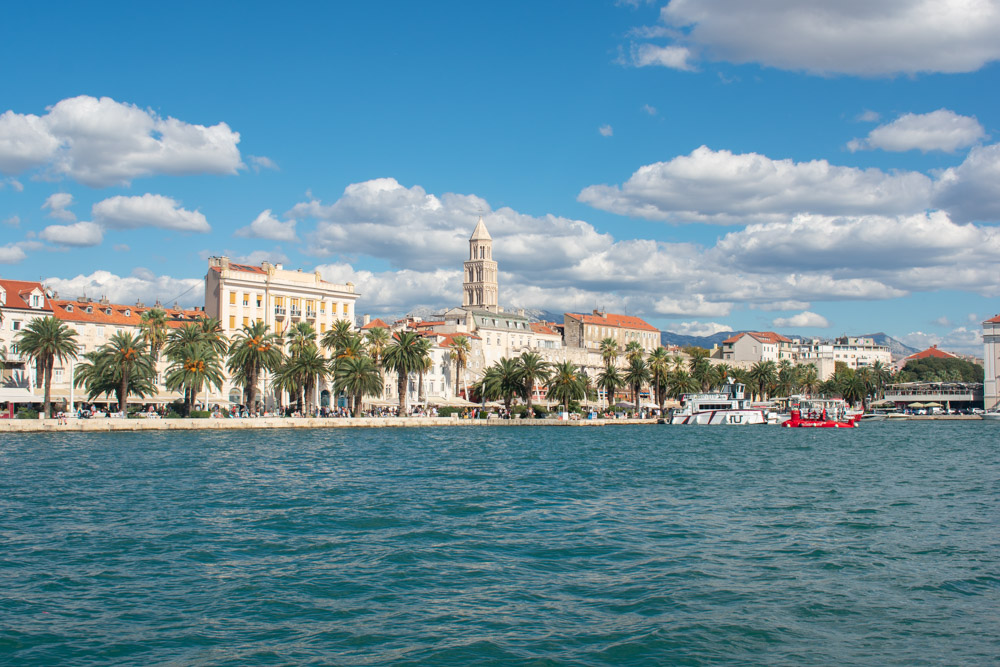
Split is Croatia’s second largest city, the largest city along the Dalmatian coast, and my personal favorite destination of this Croatia itinerary. It has a beautiful little old town, which is basically the remains of a Roman emperor’s palace from back in the 4th century. Split is also the perfect jumping-off point to get to some of Croatia’s best islands, and it has even served as backdrop to some Game of Thrones scenes. In short; I’m sure you’ll love Split!
How to Get to Split
Since it is the starting point of your ten day Croatia trip, you will need to fly into Split. Split’s international airport is Split Saint Jerome Airport (SPU), also known as just Split Airport. To get from SPU airport to the Split city center, you have two options.
- Option 1: Take a shuttle. The company Pleso Prijevoz operates shuttles from SPU to Split city center’s bus terminal (which is located here). Tickets cost €8 each way and the journey takes 30 minutes. You can buy your tickets in advance at the official site or in person.
- Option 2: Take a taxi. Official taxis are outside baggage claim and offer metered rides. This means that the price will vary depending on traffic, but you can expect a price range between €30 – €70. You can also use Uber in Split, or simply ask your hotel to arrange a pick up for you.
What About Flying Round Trip to Dubrovnik?
If you need to fly round trip into Dubrovnik airport, it’s not as ideal as getting one flight into Split and the other out of Dubrovnik (which is called a multi-city ticket or open-jaw ticket). But if it’s what you need to do, we can work with that. Just check out my section on itinerary adjustments for details on getting to Split after landing in Dubrovnik.
What to Do in Split (One and a Half Days)
One full day in Split is a nice amount of time to “see everything.” But because this is the day you first land in Croatia, you might not have an entire day (flights can get delayed, after all!). Or even if you do arrive in the morning, you might be dealing with jetlag and need to play things by ear today.
So, I’ve planned this Split itinerary assuming that you will need to take it easy on day one. This is also so that you don’t have to worry about the closing time for any entry attractions. Then, on day two in Split (which is your first full day in Croatia), you can enjoy the bulk of the things to do in Split.
But if you are starting your Croatia itinerary from already being within Europe, you may already have a full, jet-lag-free day as your first day. If that is the case, you can definitely squeeze both Split days below into one by removing the beach afternoon on day two and squishing everything else into just one day. Then, you can use the second day in Split to do an extra day trip. I give some suggestions for extra day trips in the adjustments section at the end of this itinerary.
Day One
After landing and settling into your hotel, it’s time to start exploring a bit of Split’s old town. Split’s old town is a very compact area. It’s about a 10 minute walk from east to west and a 5 minute walk north to south, just to give you an idea of the amount of ground you’ll be covering on day one.
- Diocletian’s Palace: It’s impossible to miss this attraction, since it makes up the entire old town! And I think that’s what makes Split’s old town so lovely to be in. Stroll around at your leisure, criss-crossing the various streets that make up this area and taking in the beautiful old town architecture while you do so.
- People’s Square: This pretty plaza includes Spit’s former Town Hall (Stara gradska vijećnica), as well as many restaurants.
- Radić Brothers Square: Also called fruit square, this plaza is pretty close to the previous one. It boasts some great examples of Baroque architecture and is on the way to your next stop.
- Split Riva: This is the seafront area of Split. I recommend that you walk the length of this beautiful promenade. Then, pick a spot you like to sit down, and (if you’ve timed things right!) enjoy the sunset. Your view of the sun itself will be obstructed by the hill to your west, but watching the changing colors of the sky over the Adriatic Sea is magical nevertheless.
- Peristyle: This is the main public square in central Split and was the central courtyard of the former palace. It’s where many city tours begin in the day. But at night, when it’s lit up, it has an entirely different vibe. I love it, and I’m sure you will too! Grab a seat on the steps surrounding the square, where you can enjoy the live music and watch as the sky changes from blue to indigo to black. Nearby restaurants actually lay out some cushions for you if you’d like to order a glass of wine from them, which they’ll bring out while you take the magical atmosphere all in.
Day Two
This is your first morning waking up in Split! Grab some breakfast if it isn’t offered at your hotel, and then it’s time to seize the day.
On my latest trip to Croatia, I made a habit of getting an açai bowl for breakfast each morning from a spot called Freshbox. It was right by a little farmer’s market called Green Market (Gradska tržnica), from which you can also just buy fresh fruit and other items too!
If you are looking for something a little more filling, I also liked the bagel sandwich I got from Brooklyn Bagel Co. I got a lunch-ish one, since it was later in the day when I went. But I saw that they had breakfast bagels that looked really good, too. There are two locations in Split; one in the old town, and another in the ferry terminal.
- Cathedral of St. Domnius: This was originally Diocletian’s mausoleum, but later converted into a cathedral centuries later, giving it a really cool blend of architectural styles! Be sure to climb up the bell tower for some of the best views over Split. Purchase your tickets in the office directly across from the cathedral. There are a few ticket options depending on whether you would like to enter other buildings or not. But buying just the bell tower entry will set you back €7.
- Temple of Jupiter: This was originally a Roman temple dedicated to the god Jupiter. But, like other parts of Diocletian’s palace, it became converted into something else later on. In this case, it was a baptistery. Entry on its own will set you back €3, but at that point, I recommend that you simply purchase a combo ticket when buying your ticket to go up the bell tower.
- Vestibule of Diocletian’s Palace: This was one of the main things I wanted to see in Split before my first visit! It’s often Photoshopped on top of a beach in Portugal, but even without the fake beach in view, it’s worthy of a visit on its own! It’s a domed building with a circular opening in the ceiling, and it apparently used to be the reception hall of the former palace.
- Diocletian’s Cellars: This was a filming spot for Game of Thrones! But when it’s not cleared out for filming, it’s a market where you can shop for typical souvenirs.
- Marjan Park: This hill-side* park is just to the edge of the old town and boasts great views over Split, the mountains, and the sea . *Yes, that means some stairs are required, starting from here, but I promise that it’s worth it! Once at the park, you can walk or bike around if you’d like. But the main draw really is the view over Split. If you haven’t eaten already, like I already mentioned, you can grab a meal or even just a drink or snack at Teraca Vidilica to really savor the view.
- Plaža Ježinac: This pebbly beach is a 25 minute walk from the viewpoint in the park.
- Pillars of Perpetual Love: I don’t suggest this for the pillars themselves, but rather for the skyline pics of Split that you’ll be able to take from the end of the jetty. (Just a warning though – it’s a bit smelly in this area!) You can stop here on the walk back into town from the beach above, or you can take bus 12 from this stop.
- Plaža Bačvic: This beach is a sandy alternative to pebbly Plaža Ježinac, just in case sand is your priority. But Plaža Bačvice is on the other side of town from Plaža Ježinac and Marjan Park, so keep that in mind.
Where to Stay in Split
On my first visit to Split, I stayed west of the old town. I would avoid this if you can for a short visit, since the bus and ferry terminals are both on the eastern side of the city! The walk isn’t difficult by any means if you are traveling light like we were, or if you are grabbing a taxi. But it just makes you add more time into your travel day, so be aware of that.
On my second visit to Split, I stayed northeast of the old town, now that I knew I should be closer to that side! This was a very slight uphill walk, and quite a lot of crossing streets with my phone opened to Google Maps to guide me and my luggage in the other. So again, I wouldn’t necessarily recommend it for those not traveling light, but it’s fine otherwise.
On my next visit, I want to be closer to the center of the action. So I plan to stay at one of these options, depending on whom I’m traveling with.
Where to Stay in Split
- Azur Palace Luxury Rooms: Budget option just north of old town
- Central Square Heritage Hotel: Mid-range option in the very heart of the old town
- Hotel Ambasador: Higher-end option with a rooftop pool and truly amazing views over Split, the mountains behind it, and the sea
Plitvice Lakes National Park (or Krka)
This unreal park is Croatia’s top tourist attraction and a UNESCO World Heritage site. So, needless to say, you absolutely should not miss a day in Plitvice Lakes National Park! It brings in over a million visitors every year and is both Croatia’s oldest and largest national park. I got quite unlucky with the weather on the day I visited, so my photo below absolutely does not do the park any justice at all. But trust me when I say that, even in gloomy weather, this park is definitely something well worth experiencing. With wooden walkways and comfortable hiking trails that guide you through a series of interconnected lakes and take you right up past the cascading waterfalls, Plitvice is a turquoise dream land.

How to Get to Plitvice Lakes National Park from Split (and Back)
Hop on an early morning bus from Split’s main bus terminal (near the ferry port) to Plitvice Lakes National Park. The bus will be a large, comfortable coach bus, and it even has good WiFi inside. The ride should take 3.5 hours and cost around €30 each way. You can book tickets ahead of time online from Flixbus (affiliate link), but the bus is actually operated by a local company, called Prijevoz Knežević. So don’t get confused and if you don’t see the typical green, Flixbus branding!
While you are making this purchase, go ahead and book the ticket as a round trip. Visiting Plitvice Lakes really is an all day affair, and there are eateries inside the park where you can enjoy a coffee upon arrival and lunch later on. So give yourself plenty of time by selecting a late bus back from Plitvice to Split.
What will this look like? Well, the first bus to Plitvice departs Split at 7:00am daily and arrives at 10:30am. In the shoulder season, the last bus back to Split from Plitvice departs at 4:20pm, but due to traffic, the journey takes 4.5 hours instead of 3.5 hours, so you arrive in Split at 8:45pm. In the high season, there’s an additional bus leaving from Plitvice at 6:00pm, by which time the journey takes 3.5 hours again, getting you to Split at 9:30pm.
So in the high season, you have a few options. But in the shoulder season, if you DIY the trip, you are looking at something like:
- 7:00am depart Split
- 10:30am arrive Plitvice
- 5 – 5.5 hours to enjoy Plitvice Lakes
- 4:05pm be at the bus early
- 4:20pm depart Plitvice
- 8:45pm arrive Split
If you prefer to not to deal with booking multiple bus and entry tickets, there is the option to take a guided tour from Split including entry into the park. Surprisingly, the cost is pretty similar to the total cost of DIY-ing each purchase yourself.
But if that all sounds horrible to you, don’t worry, because there is a very similar substitute for Plitvice National Park. And it’s much closer to Split, making for a much easier day trip. It’s called Krka National Park.
Krka National Park
Krka was once a proper contender with Plitvice, because you used to be able to swim at Krka, which you couldn’t do at Plitvice. So visitors to Croatia who didn’t have enough time for both parks had to decide between visiting the better park that you couldn’t swim in (Plitvice) or the lesser park that you could swim in (Krka).
But now that Krka no longer allows swimming, it’s kind of lost the advantage it once had over Plitvice. Now, visiting Krka feels redundant if you’re visiting Plitvice, irrespective of how much time you may have in Croatia to visit both.
But for a ten day Croatia itinerary, things change, because you will be focusing your time on the southern half of the country. This makes Plitvice a pretty big detour from everything else you are seeing. So Krka once again becomes an attractive option. And, once again, you have a choice to make. Now, it’s a choice between the better park that is 7 – 8 hours in a bus round trip (Plitvice) or the lesser park that is 3 hours in a bus round trip (Krka).
How to Get to Krka National Park from Split (and Back)
Hop on a morning bus from Split’s main bus terminal to Skradin. Again, the bus will be a large, comfortable coach bus with WiFi inside. The ride should take 1.5 hours and cost around €12 – €15 each way. You can again book tickets in advance online from Flixbus (affiliate link), and the bus is again operated by the same local company, Prijevoz Knežević. So, again, don’t get confused and look for the usual green, Flixbus branding.
While you are making this purchase, go ahead and book the ticket as a round trip journey. Krka is less than half the size of Plitvice, so there is less reason to allot yourself several hours in the park if you don’t want to. But I would still recommend that you budget at least 3.5 – 4 hours here and select a return bus time that accommodates that.
Like with Plitvice, you can alternatively just book a tour that includes transport to Krka from Split. But these tours usually don’t include your entrance ticket. So you’d still have to purchase that separately upon arrival. I feel like that takes away a lot of the benefit of the tour, unlessssssss you take advantage of the time saved visiting Krka rather than Plitvice by booking a tour that combines somewhere else with Krka, like this Krka tour that stops at lovely Trogir, or this Krka tour that stops at Primošten for a swim.
What to Do in Plitvice Lakes National Park
The main thing to do in Plitvice Lakes National Park is to walk the trails, which takes the better part of a day. You’ll want to stop by the information center at the entrance to get an overview of your day before starting. They can explain the trail routes, the train ride back at the end, the ferry ride in the middle, and where to buy food if you haven’t packed your own.
Within the park, there are a few different routes, or “programs,” that you can take, depending on whether you want to walk the largest park route or do shorter routes. Like I said, there are maps of these routes near the entrance. But if you prefer to get an idea ahead of time, you can check out the programs online.
To enter the park, expect an entry fee of around €40 from June to September. If visiting Plitvice any other time of year, expect €23 in April, May, and October, and €10 in winter. You can use the official site to double-check fees and even book ahead online, which I highly recommend that you do in high and even shoulder seasons.
What to Do in Krka National Park
Just like at Plitvice, the main thing to do at Krka is follow the routes and enjoy the scenery! So once you arrive at the Skradin bus stop that you get dropped off at from Split, walk 5 minutes or so to the Krka National Park office. Then, buy your ticket, which includes a ride on a boat ride that takes you into the park.
This ticket will set you back €40 if visiting between June and September. But the price drops to €20 during the months of April, May, and October, and to €10 in winter. You can use the park’s official site to confirm entry prices and even book tickets in advance online. You can also get an idea of the park’s routes or “programs” by skimming the official brochure.
Which Park to Visit – Plitvice or Krka?
The age old Croatia question – should I visit Plitvice, Krka, or both? I’ve already given my opinion that I do not think visiting both Plitvice and Krka on a short trip is worth it anymore, now that you can’t swim at Krka.
You should choose to visit Plitvice if some of the below is true:
- You have major FOMO and want to see the much better park of the two
- You may not return to Croatia in the future
- You are able to nap on buses, so that the 7 – 8 hour bus ride isn’t wasted time
- You can be productive on the bus, like editing your photos from previous days
You should choose to visit Krka if:
- You don’t really suffer from FOMO and simply care to see nice waterfalls
- You might return to Croatia in the future to see things further north than Split
- You will be awake with nothing to do and no one to talk to during the bus rides
If you really don’t care for waterfalls and prefer to use this day as another day somewhere coastal, I provide a lot of options in the adjustments section of this post.
Hvar
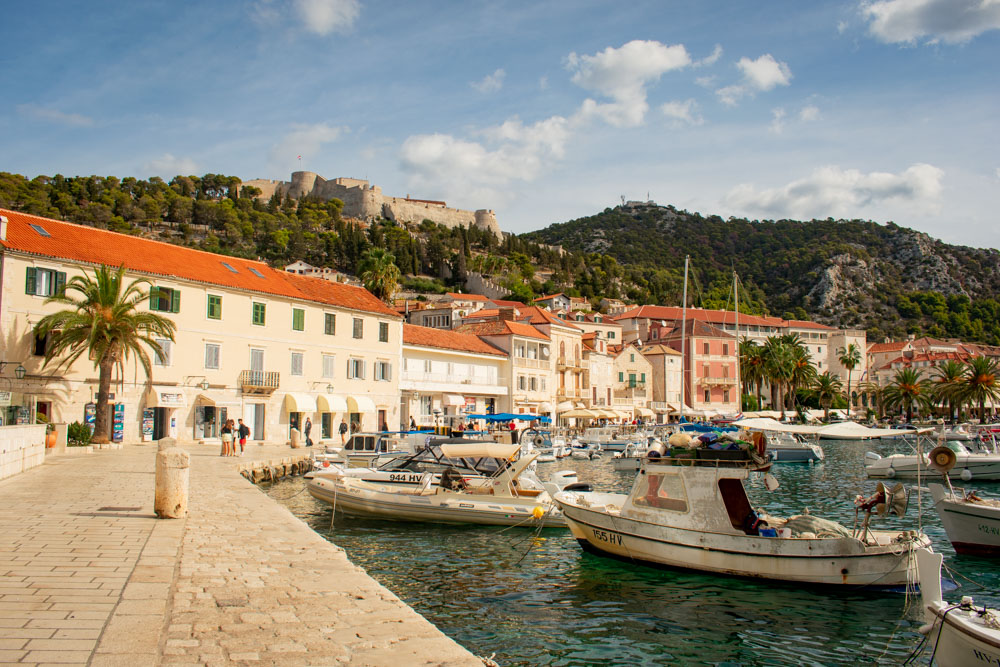
There’s nothing more Croatian than a beautiful island, so you shouldn’t leave Croatia before seeing at least a couple of them. On this ten day Croatia itinerary, you’ll start with the most popular island to visit, which is the island of Hvar. More specifically – you’ll visit the town of Hvar Town. It boasts impressively clear water, orange rooftops, and an imposing fortress, making Hvar Town the picture perfect island destination.
How to Get to Hvar from Split
Make your way to the Split ferry terminal and catch a ferry stopping at Hvar island. The journey from Split to Hvar Town (not *Stari Grad!) takes 50 – 70 minutes and costs €20 – €25, depending on the ferry company. The ferries depart from right near the bus terminal, which you all but certainly used for your day trip to Plitvice or Krka. The schedule differs throughout the year. So you can look up the ferry schedule in advance online using the links I provided in the transportation section of this guide up above, or check it out in person at the terminal.
* There are several different ferries and catamarans stopping at different ports in Hvar. You want a ferry that stops at the port of “Hvar.” This will be directly to where you want to go; Hvar Town. Some ferries will instead be heading to “Stari Grad.” This is another port on the island of Hvar. From Stari Grad, you would need to take a short cab ride to Hvar Town. Taxis will be waiting at the port, so find some other travelers from your ferry journey who are also heading to Hvar Town (most will be) and split the price of the taxi. (This is what I did on my first time in Hvar!) But as you can see, it’s best to just get a ferry to “Hvar” and not to “Stari Grad” unless you absolutely have to.
What to Do in Hvar (One Day)
In order to maximize your day exploring Hvar without having to rush, I recommend that you take a ferry departing Split by around 11:00am at the latest. Your accommodation’s check-in time is likely much later than the time you’ll arrive in Hvar Town. So you may need to drop your bags off at reception if you are staying in a proper hotel or hostel.
If you are staying in some sort of apartment, you can leave your bags in luggage storage. There are storage options right by the harbor, like Bounce Luggage Storage and Radical Storage (which you can book online). After dropping your bags off at your hotel, it’s time to hit the town!
- St. Stephen’s Square: At the far end of the square is St. Stephen’s Cathedral (Katedrala sv. Stjepana). It charges a fee for entry, but it honestly isn’t all that intricate or unique, so I just recommend you enjoy its pretty facade and bell tower from the outside. Also, whenever you’ve worked up a bit of an appetite, there are a lot of options in St. Stephen’s square and along the harbor. So you can just stop at whatever looks (or smells!) good as you explore this area.
- Venetian Loggia and Clock Tower: They’re what’s left of what once was the governor’s palace, back when Hvar was under Venetian rule. (Just like in Split, you’ll notice a lot of buildings Hvar that may remind you of Venice or Verona, in Hvar Town.) You can enter for €5.
- Plaža Lučica (and Franciscan Monastery): Around midday, it should be getting pretty warm out, so it’s time to get some vitamin sea in! Make your way back towards where the ferries are, and then keep walking along the path. You will eventually turn a corner, seeing the Franciscan Monastery in the slight distance and the loveliest little cove in front. This exact image is actually a very frequently-pictured one online, so it may even look familiar. Keep walking ‘til you reach the cove, called Plaža Lučica. I loved swimming here, so if you’re happy with what you see, feel free to lay out your towel and post up for the rest of the afternoon.
- Pokonji dol: If you’re willing to get some more steps in, I actually recommend that you keep walking past the cove and monastery that I mentioned in the bullet point above. Follow the coastal sidewalk, which boasts seaside views the entire stroll, until you reach Pokonji dol Beach. If you prefer this beach for your afternoon swim, then stay here. If you prefer the cove by the monastery, then simply snap your pics of Pokonji dol Beach and head back to Plaža Lučica to swim.
- Beach Bonj Beach: Both of the beaches I’ve mentioned above are quite casual. They’re pebbly (so I recommend wearing water shoes!), and you can lay your own towel out. Totally my vibe! But if you want more of a beach club experience, then I recommend that you walk the opposite direction from the main square, instead of towards the ferries. As you walk along that sidewalk, you’ll hit beach clubs that you can choose from, like Bonj Beach. They serve food and of course drinks.
- Fortica Fortress (Tvrđava Fortica): Sitting high above Hvar Town is the Fortica Fortress, formerly called the Spanish Fortress (Trvđava Spanjola). It offers the best view in town – the cliche one in all the Hvar brochures! And while it requires an uphill trek to reach, the *path is pretty manageable if you give yourself enough time to go slowly. You do have to walk up the steep old town steps at first. But once that is out of the way, it is a slow ascent through a lovely garden of sorts. I recommend that you start the 20-ish minute walk from the main square (exact spot here) around 2 – 3 hours before sunset. That way, you avoid the midday heat and, more importantly, get the best lighting as you enjoy the view of the sun lowering behind the Pakleni Islands in the distance. Entry is €12 and is quick to buy in person once there. If you don’t want to pay for entry, there are still very decent views from outside the fortress. But the un-obstructed, panoramic view from inside is definitely best.
* Those unable to walk up can take a taxi ride to the fortress.
Where to Stay in Hvar
I loved the accommodation I stayed at in Hvar Town. And I was fully planning on rebooking it on my next visit. But it unfortunately seems to no longer be accepting bookings! So I instead recommend staying in one of the below options.
Where to Stay in Hvar
- Heritage Hotel Dea Hvar: Lower-mid-range option just 3 minute’s walk from where ferries dock, but requiring some steps (like much of hilly Hvar Town)
- Heritage Hotel Park Hvar: Higher-mid-range option located a flat, 7-minute walk from where ferries dock, and right in center of Hvar Town.
- Amfora Hvar Grand Beach Resort: Higher-mid-range option with a pool and rooftop restaurant, for those wanting a relaxing, resort experience while on Hvar
Island Hopping
In order to see a variety of what the islands around Hvar have to offer in a short amount of time, you should definitely book an island hopping tour. I joined this type of tour at the last minute on my first trip to Croatia, and it was the single favorite thing of the trip. I was very reluctant about the price at first, especially because it was early May and the weather had been iffy. So I didn’t know if the skies would cooperate or if the water was warm enough to swim in yet. In the end, I loved the tour and only wished there were more hours in a day.
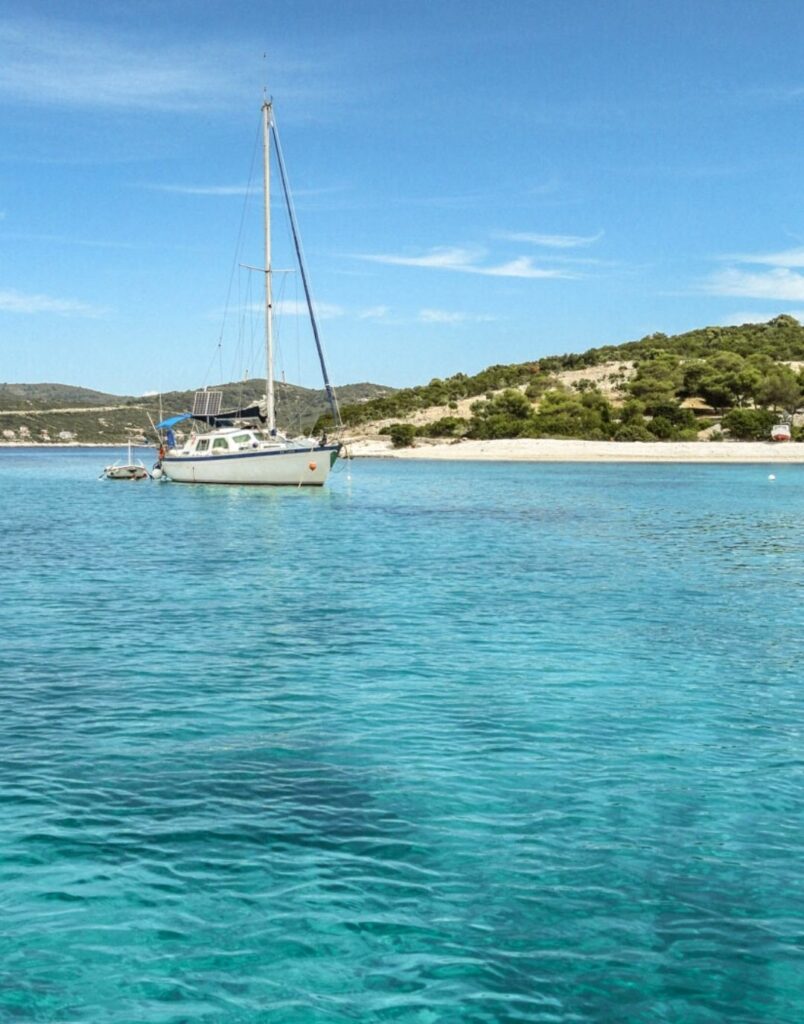
Our tour group included two bay boats that could fit around 8 people each. We started in Split* in the morning around 8:30am. But these same types of tours depart from Hvar, too. This is actually better than doing the tour from Split, because you save one hour of transport in the morning, meaning you can sleep in one hour later. And, I mean, who doesn’t love that? You are on vacation, after all!
We returned from the tour as the sun was setting, after hitting all the below sites:
- Blue Grotto (or Cave): A natural sea cave on Bisevo island with waters that glow bright blue from light coming through an underwater opening.
- Green Grotto: Another cave that is somewhat similar to the Blue Grotto, but it is green and located on the southern side of Vis island
- Stiniva Bay: One of Croatia’s most famous beaches, which is located on Vis Island, but sadly the tour just does a drive-by stop to look and snap pics rather than allowing for time to stop and get out
- Lunchtime and swimming on a smaller island
- Swimming on a different smaller island
- Hvar Town: We got about 1.5 hours to explore Hvar Town, since we did the tour from Split. But for your tour from Hvar Town, this stop would obviously be switched for more time at the other stops
How to Island Hop from Hvar
These types of island hopping tours are advertised all over Split and Hvar (especially in the tourist offices) for around €120 – €150. But if you prefer to have all your T’s crossed and I’s dotted before you depart, or if you don’t love going from kiosk to kiosk in person and making decisions on the spot in front of the person selling (*raises hand*), you can also book these online.
This tour follows the exact same route I did on my island hopping tour during my first visit to Croatia. It also allows free cancellation up to 24 hours beforehand. So you get the benefit of securing the tour before it could sell out, while still having flexibility to cancel if you get unlucky with the weather or find something better in person. If you are traveling in a group, though, it could be worth it to split the cost of a private boat tour.
Korcula
I have traveled the entire length of Croatia’s coast, entering from Montenegro to the south and exiting into Slovenia to the north. So while I haven’t seen everything, I’ve definitely seen a lot! And the clearest water I have seen in my Croatia travels so far has been in Korcula. And that is saying a lot, because Croatia’s water in general is GORGeous! With just one week in Croatia, you’d likely have to choose between either Hvar or Korcula (like I had to know my own first visit!). But with ten days in Croatia, you have plenty of time to visit both stunning islands.
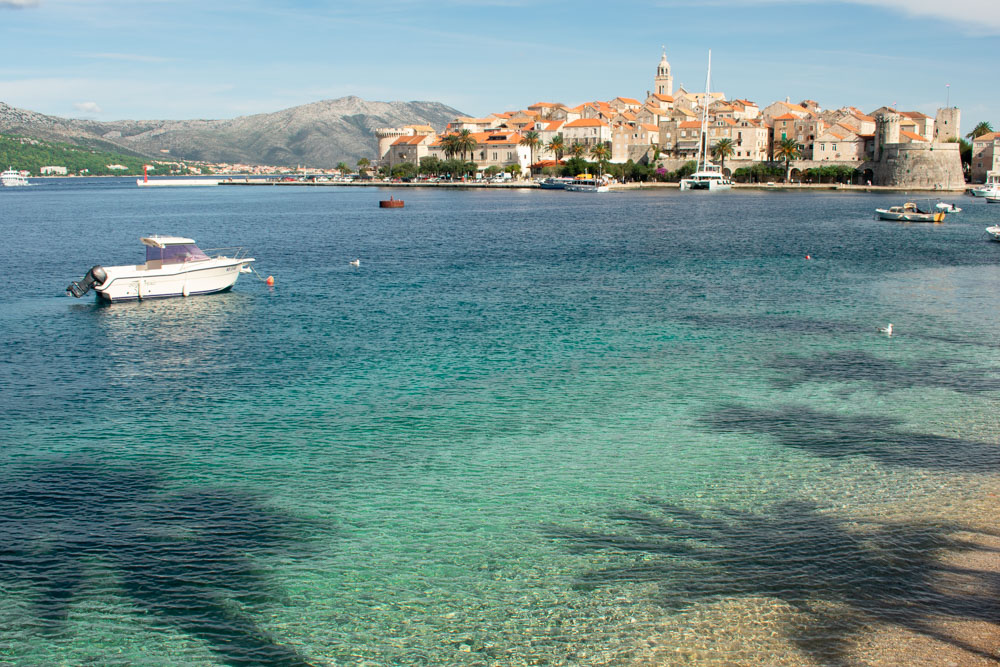
More specifically, you’ll be visiting Korcula Town, often called the mini Dubrovnik due to its beautifully preserved walls. It is a lot calmer than Hvar Town, because not as many tourists make it out to Korcula compared to Hvar.
How to Get to Korcula from Hvar (*and Back)
Make your way to the Hvar ferry port (the same place you arrived when you came to Hvar from Split) and catch a ferry to Korcula. Make sure you are traveling to the town Korcula, and not Vela Luka, which is another port on the island. The journey from Hvar to Korcula town in the mornings takes 70 – 85 minutes and will set you back around €25 each way, depending on the ferry company. The latest ferry back* from Korcula town to Hvar departs around 5:00 pm in high and shoulder season, so keep this in mind when deciding your departure time from Hvar.
Again, these schedules vary throughout the year. So, as always when using ferries in Croatia, check the ferry schedule in advance online using the links I provided in the transportation section (jump text) of this itinerary up above. You can also consult with the ferry companies at their offices (which are near the port) on your first day in Hvar. You can then purchase tickets in person there, too.
* If you prefer to save transport time and don’t mind adding one check-in and check-out to this ten day Croatia itinerary, consider spending the night in Korcula instead of visiting it as a day trip from Hvar. You have to pass by Korcula anyway on the day you travel from Hvar to Dubrovnik (which is the next section of this itinerary), so by staying in Korcula overnight, you avoid doubling back, saving time and ferry ticket money.
Dubrovnik
Thanks to Game of Thrones and Star Wars, tourism in this walled little city by the sea has *exploded. Add that to all the cruise ships that stop here, and you’ve got yourself a very crowded little old town in the summer months. But if you take advantage of the mornings and the evenings after the day trippers have left, you’ll be able to enjoy Dubrovnik, its cute alleyways, and spectacular Adriatic views a bit more.
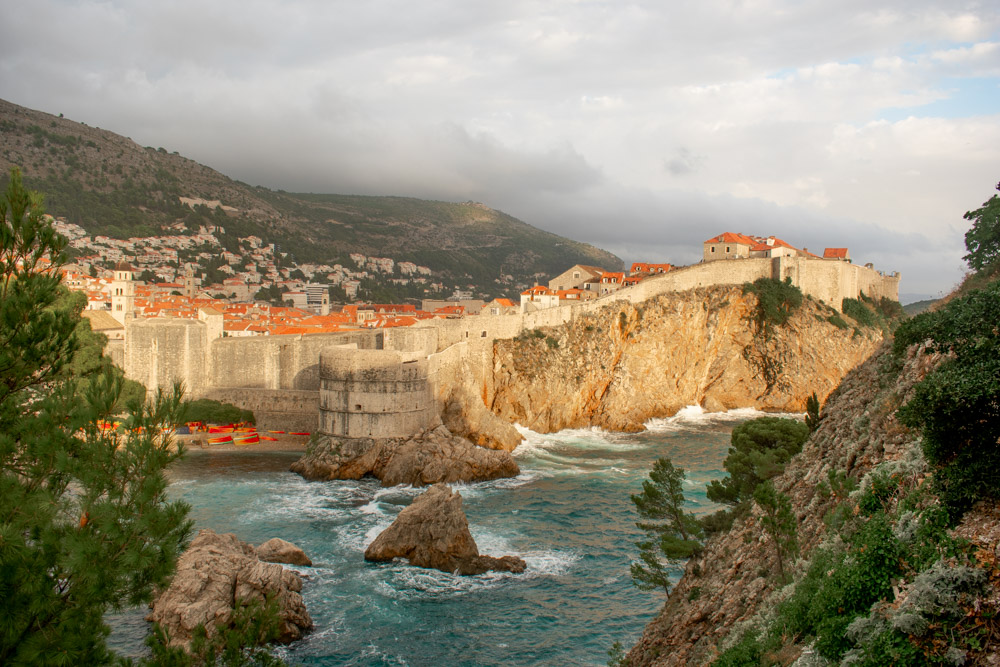
* If you are worried about crowds, the city actually has this “crowd predictor.” I haven’t used it, so let me know how accurate you find it if you go!
How to Get to Dubrovnik from Hvar
Make your way to the Hvar ferry port (the same place you arrived when you came to Hvar from Split) and catch a ferry to Dubrovnik. The journey from Hvar to Dubrovnik in the mornings takes 3.5 – 4 hours and will set you back around €50, depending on the ferry company. Again, these schedules vary throughout the year. (Some months, this route actually ceases to operate.) So you should check the ferry schedule in advance online using the links I provided in the transportation section of this itinerary up above. You can also consult with the ferry companies at their offices, which are nearby the port. You can purchase tickets in person there, too.
I recommend that you take the *earliest ferry from Hvar, which departs at 9:10am. The journey is just under 3.5 hours, meaning you will get into Dubrovnik around 12:30pm. Before getting on the ferry, you can grab a sweet treat and coffee for breakfast from nearby Nonica Caffe Bar (unless it’s Sunday, in which case it won’t have opened yet).
* There is another morning ferry just 1.5 hours later between the months of May and October. So if you need to arrive in Dubrovnik a bit later (around 2:45pm) in order to make things more convenient for your accommodation’s check-in time, that is an option. But I recommend taking the earlier ferry if you can. It will of course allow you to have close to two full days in Dubrovnik, rather than just 1.5 days.
What to Do in Dubrovnik (Two Days)
The top attraction in Dubrovnik is, without a doubt, the city walls. So you probably will walk them (most people do!), and the price to do that is actually the exact same price at the One Day Dubrovnik Pass. The pass also gives you access to a 24 hour bus pass, and there are options for a 3-day and 7-day pass, too. You can read more about what’s included and even purchase the pass in advance online from the official site.
Feel free to rearrange my days 2, 3, and 4 in Dubrovnik however you see fit!
Day One
Your first day in Dubrovnik will be more like a half-day, since it’s the day that you travel to Dubrovnik from Hvar. But don’t worry – you’re going to maximize the time you have today to explore the old town, walk the famous walls, and even enjoy a dip in the sea if you fancy.
By the time your ferry gets into Dubrovnik and you make your way from the port to your accommodation (around 1:00pm), hopefully it’ll be check-in time. If not, you can typically leave your things with reception while your room is still being prepared, assuming you have booked a proper hotel or hostel and not an apartment. If you have booked an apartment or AirBnb, let your host know of your arrival time beforehand to see if they can accommodate your arrival time.
In any case, drop off your things, freshen up, and head out to grab some lunch before exploring Dubrovnik. But before you do, I recommend that you ask your receptionist or host to help you make dinner reservations somewhere they recommend for later that night. Then, it’s time to start exploring Dubrovnik!
- Pile Gate: If you haven’t already, it’s time to finally enter Dubrovnik’s walled Old Town! I recommend doing so through Pile Gate, which is the main entrance to the Old Town of Dubrovnik. As you walk the stone bridge (which was a drawbridge over the former moat way back when) leading up to the gate, it’s so easy to imagine what it must have been like centuries ago! And it’s no wonder so much of King’s Landing was filmed in Dubrovnik (many scenes actually around this very gate!).
- Stradun Street: As soon as you pass through Pile Gate, you’ll be on Stradun Street. This is the main pedestrian street of Dubrovnik’s old town. It starts at the main gate, Pile Gate, and goes all the way to the other end, by the old port.
- Onofrio’s Large Fountain: When you step onto Stradun Street, you’ll notice a large fountain to your right. In addition to being the end point of a 15th century aqueduct, it’s a popular meeting point for walking tours.
- Franciscan Church and Monastery: Also near the start of Stradun Street, on your left, is one of the oldest continuously operating pharmacies in all of Europe, and the third oldest one in the world. It dates back to the 1300s and is located inside the Franciscan Church and Monastery, which you can enter and also has pretty cloister. Entry is included in the Dubrovnik Pass that I recommended above.
- Luza Square: Also known as the Square of the Loggia, this is the main square in Dubrovnik. It used to be the spot for public gatherings, announcements, trials, and ceremonies back in Dubrovnik’s medieval days. While in Luza Square, be sure to check out Orlando’s Column, which is dedicated to a legendary knight (named Orlando, duh), who apparently stood for freedom and justice and all that good stuff, as well as the Clock Tower of Dubrovnik.
- Sponza Palace: Before leaving Luza’s Square, walk over to Sponza Palace. It was built in the early 1500s as the city’s customs house where merchants declared goods and paid duties. This building is special because it’s one of the few that survived the city’s earthquake, allowing us to enjoy its 16th-century architecture today. Entry will set you back €5, since it is not included in the Dubrovnik Card. Even if you don’t care to enter, at least take some minutes to appreciate the pretty columns of the exterior.
- Saint Blaise’s Church: While in the area, also check out Saint Blaise’s Church, at least from the outside if not from the inside as well, since entry is free.
- Rector’s Palace: Walk past Saint Blaise’s Church until you hit another building with pretty columns – the Rector’s Palace. Rector is what the leader of Dubrovnik was called back when Dubrovnik was known as the Republic of Ragusa. Today, it’s the Cultural Historical Museum. Entry is included in the Dubrovnik Pass, but on its own, it’ll cost you €15 in person or at the official site.
- Cathedral of the Assumption of the Blessed Virgin Mary: This church, also known as Dubrovnik Cathedral, is on the way from the previous bullet point to the next one. So take a peak instead if you’re curious, or just admire the Baroque architecture from the outside if not.
- Church of St. Ignatius and Jesuit Stairs: Make your way to nearby Gundulić Square before heading to probably the most famous site within Dubrovnik’s walls! From Gundulić Square, walk by the terraces of the restaurants lining the side of the square. You’ll see a beautiful staircase – does it look familiar? (If not, that’s fine – it just means you haven’t watched Game of Thrones!) Made very famous for being the filming site of Cersei’s walk of shame, the Jesuit Stairs will definitely have a crowd of people vying for their perfect pic. But even without the GOT hype, it’s simply a beautiful staircase. The stairs and the Church of St. Ignatius, which they lead up to, were apparently inspired by a lot of Roman churches. So it actually looks a bit like a mini version of the Spanish Steps staircase in Rome!
- Buža Beach: If you’ve worn your swimsuit underneath your outfit (which is always a good idea in Croatia!), it’s time to get a swim in! Just a short walk away from the Church of St. Ignatius is everyone’s favorite cliff-jumping spot in Dubrovnik, aka Buža Beach. I’m not really sure why they’ve named it a beach, since it is far from a beach. It’s literally just a large chunk of rock, which you reach by a literal hole in the wall(s of Dubrovnik). But with its misleading name, it’s such a great vibe. Head to the edge of the wall and just follow signs saying “cold drinks, beautiful view.” You’ll find a simple but viby cafe serving drinks on the rocks, and just below is where you can take a dip in the sea if you’d like. Unfortunately for me, both times that I’ve had the chance to swim and hang out there have coincided with rainy weather! I can only hope that third try’s the charm, because I definitely will continue returning to Croatia again and again and again.
- City Walls of Dubrovnik: These bad boys are practically synonymous with the word “Dubrovnik” itself, and they’re seriously some of the best preserved medieval walls in the entire world. Most of it was built between the 1200s and 1500s, and they were never breached in all of the Republic of Ragusa’s 500 years, keeping Dubrovnik safe from everyone from the Venetians to the Ottomans to later the French and the Habsburgs. Entry will set you back €40 and can be purchased on the spot, but I recommend purchasing tickets in advance in the high season, either on the official site, or as part of the Dubrovnik Pass. The wall walk is about 2 km or 1.25 miles long, and it should take you 1 – 2 hours to do the entire loop, depending on how many stops you make for photos, resting, or simply taking in the views. For that reason, I recommend starting your wall walk 2 – 3 hours before sunset. Around sunset is when you’ll enjoy the best lighting, not only for photos, if those are important to you, but simply to enjoy the look of the orange rooftops and the changing color of the sky. The walk is fully exposed to the sun, so bring a hat and a water bottle. There are toilets dotted throughout, as well as places to grab a bite. One spot with a really amazing view is Caffe on the Wall (SV. PETAR), where you can sit and have a drink before continuing on with the rest of your walk.
Extra ideas:
- War Photo Limited Museum: If you find yourself with extra time, or if you get stuck with a rainy day like I did, check out the WAR PHOTO LIMITED Museum. It features an exhibition documenting the recent-ish wars (the 1990s) that Croatia and its neighbors have suffered. I learned a lot, and it was really good to balance all the aesthetic beauty that is Dubrovnik with appreciation for what its residents have had to go through. Entry will set you back €10.
- Sit on the Iron Throne: Non-GOT watchers can keep scrolling. But those who’d like to pretend they are ruler of The Seven Kingdoms can stop by Dubrovnik City Shop – IRON THRONE for a photo op on a plastic iron throne. Yours truly may or may not have done this herself.
- Game of Thrones Walking Tour: On my first visit to Dubrovnik, my friend and I weren’t sure whether to opt for a normal walking tour of the significant sites or a Game of Thrones sites tour, since we were both fans of the show. Luckily, we found a half-Game-of-Thrones-half-history walking tour! It was the perfect way to start off our trip by hitting up all the most famous filming sites and the actually significant sites without having our phones out the whole time to lead us from site to site. This tour is pretty similar to the one we did.
My Dubrovnik travel tip: Make sure to leave yourself some time to wander Dubrovnik’s stoney streets with no plan. The main area is super crowded, due to how small Dubrovnik is and the fact that it’s a cruise ship port of call. But the rest of the old town – the part that doesn’t have the main attractions – is honestly SO QUIET in comparison. So grab a gelato (I liked the one I got from this gelateria), and just let your feet lead your way.
Day Two
Start this first full day in Dubrovnik bright and early! You’ve got a really fun but packed day ahead. You can grab a to-go breakfast from Holy Burek Dubrovnik or Mlinar. They’re nearby each other and both sell bureks, which are typical savory pastry from the Balkans. I pretty much lived off these flakey, cheese-filled things when I solo-traveled up the Balkan coast a couple summers back, especially in Albania and Northern Macedonia. But if you’re wanting something sweeter, Mlinar sells other baked goods too.
- Fort Lovrijenac: Also known as St. Lawrence Fortress, this is the fort across from the main walled town. You’ll have seen it in the slight distance while you walked the walls yesterday. Like a ton of other spots in Dubrovnik, this was a filming location for King’s Landing in GOT. It was apparently used for scenes involving the Red Keep, though I don’t really remember that. I more remember it in the background of scenes where characters are looking out over the sea. But I digress! Whether you watched the famous show or not, climb here to get that cliche view of walled Dubrovnik. Entry to the fort is actually included with the ticket you bought to walk the walls (it should be valid 72 hours after you walked the walls), as well as in the Dubrovnik Pass. But you can technically pay €15 to enter the fortress only if you didn’t pay for the ticket to walk the walls or the city pass. In any case, you get views that are worth the trek even just by climbing to the entry and skipping entry if you are short on time. You can buy tickets in person (there wasn’t much of a line when I went) or online from the official site .
- Dubrovnik West Harbour: This small bay between the fort and the main walled town appears many times in Game of Thrones as the “jetty” and bay from which various characters depart when leaving King’s Landing. But don’t worry – I’m not only sending you here for that!
- Kayak: This was seriously one of the highlights of my first visit to Dubrovnik, probably second only to walking the walls during golden hour. The kayaking tour (which you can check out here) has multiple departure times. But you’ll probably want to choose the 10:20am time slot to stay on schedule for this itinerary as I suggest it. After kayaking and swimming all morning, you’ll have worked up quite the appetite, I’m sure! So after a quick rinse at your hotel if needed, grab a bite to eat before continuing on with the rest of the day.
- Choose one of the following (since you won’t have time for all three) before washing up for dinner with a view later (the last bullet point!):
- Option 1: Visit Lokrum Island. That island you see just behind Dubrovnik in all the pictures? That’s Lokrum. I recommend this first option if you enjoy light hiking, swimming at rocky beaches, and want to enjoy views of Dubrovnik from the sea. Oh, and also if you like peacocks. The island is filled with them! To get to Lokrum, head to Tirena Dock, which is located here. This is where the water taxi or “ferry” to Lokrum departs from. The ride takes 10 – 15 minutes each way and will set you back €30 round trip. You can get more info at the official site, if you’d like. Once you’ve made it to Lokrum, you can hike one of the many paths, explore the Benedictine Monastery of St. Mary and the Fort Royal, and swim in the “Dead Sea” or many other swim spots. Fun fact for GOT fans: The island of Lokrum – particularly the botanical gardens and the monastery – was a filming site for the city of Qarth (which Daenerys visits in season two). I needed to jog my memory on Qarth, so this post was helpful for me!
- Option 2: Have a relaxing day at a beach in Dubrovnik. If you think you’ll want break after kayaking this morning and walking all of yesterday afternoon, you’ll probably want to take the rest of the day to swim and relax at a beach. As I mentioned, I got really unlucky with weather on both my visits to Dubrovnik so far. So I haven’t gotten to enjoy any Dubrovnik beaches from my list yet. But a few that I am hoping to finally luck out on weather and visit on my eventual third visit to Dubrovnik are:
- Banje Beach (Plaža Banje): This is the top one on my list, due to its view of Dubrovnik’s walls in the distance and its proximity to the old town. It’s just a 10 minute walk from the eastern edge of the walls, or a 15 minute walk from Pile Gate.
- Sv Jakov Beach (Plaža Sveti Jakov): This is only #2 on my list due to the fact that it’s further away than the previous beach. It offers a similar view of the old town (from more of a distance, but from an angle that exposes more of the wall). It’s a 35 minute walk from Pile Gate, and I don’t see any buses that say they head there. So you might want to grab a cab if you have someone to split the cost with. The beach is apparently at the bottom of a lot of stairs, though, so keep that in mind!
- Option 3: Day trip to the Elafiti Islands. These islands are a small archipelago near Dubrovnik. Three of them (Kalamota, Lopud, and Sipano) are inhabited, and these three are the main ones people visit, normally via a tour. I visited all three on my first trip to Dubrovnik. Lunch was included in the tour package, and I felt that they gave us a good amount of time to explore each island at our leisure. The site where I booked my tour is no longer up. But this tour is identical to the one I did. (Honestly, I’m pretty sure that the guys running my tour are now listing theirs on that site.)
- Dubrovnik Cable Car: Behind Dubrovnik is a really steep mountain, and tonight you’re finally going up it! First, make your way to the cable car’s lower station. It is located just outside the city walls. The ride takes just a couple minutes, and tickets are €27 round trip, or €15 one way (I guess for those who’d like to hike up or down!). You can purchase them in person or in advance at the official site. Ride the Dubrovnik Cable Car up to the observation deck, where you can take in the almost bird’s eye view of Dubrovnik, its islands, and the sun setting on the right side of the horizon. Afterwards, make your way to Panorama Restaurant, where you can continue enjoying the view and the sunset without any rush as you have dinner. You’ll definitely want to make your reservation in advance at the official website. After a magical meal, ride the cable car back down to either walk off your dinner in the lamp-lit streets of Dubrovnik or call it a night.
Now, between the price of the round trip cable car ride and the meal, I imagine that some of you will want some alternative options for this dinner, especially if you end up with a cloudy forecast on this night.
- Adrenaline option: If between kayaking, hiking around Lokrum island, and swimming at the beach, you still haven’t gotten your fill of adventure today, then this option is perfect for you. I had NO IDEA this existed on my first visit to Dubrovnik. But I absolutely would have wanted to do this back then when I was a faux adrenaline junkie. It’s ziplining over Dubrovnik during sunset! They pick you up and drive you up the mountain, you zipline two lines a couple times each, and then you finish watching the sun go down with a glass of local wine before they bring you back down to Dubrovnik. So if you want to get the cable car view but prefer something a little more exciting than the very short cable ride up and then down, the ziplining tour will be a great option for you.
- Budget option: If you’d like a more laid-back option for dinner and a view tonight, then this option is for you. After washing up at the hotel, head back to Buža Bar for drinks at sunset (this place is cash only). Just be aware that sunset from here is only fully visible from late September to April. So you’ll be here more for the vibes and the changing color of the sky, rather than to actually witness the sun lower into the sea. Once you’ve finished at Buža, head to dinner at your restaurant of choice within the walls (ask your reception to help you make a reservation again).
Where to Stay in Dubrovnik
On my first visit to Dubrovnik, I stayed in the walled old town. The building we stayed in was so cute and pretty! But this required an extra bus ride with our bags from where the buses and ferries stop, which is quite south of the walls, and then of course rolling our bags over the slippery, cobbled streets and carrying them up some stairs. It really wasn’t an inconvenience for us, since we packed carry-on only. But it’s definitely something to be aware of if you are traveling with more luggage than we were.
On my second visit to Dubrovnik, I was staying fewer nights than on my first visit. So I decided to stay walking distance from the bus station, since I was traveling by bus both in and out of Dubrovnik. This meant that I had to take a bus from there into the walled old town area and then back later on.
So each option has its pros and cons! Below are my recommendations for a place inside the walls and outside the walls. But if you’d like to be close to the best bars and nightlife, I’d say that staying within the walls would be your best bet.
Where to Stay in Dubrovnik
- Bed&Breakfast Andio: Budget option within the city walls
- Royal Neptun Hotel: Mid-range option outside the walls for those wanting the best sea views and access to a private beach, with good suite options for those traveling in larger groups
- Boutique Hotel Stari Grad: Higher-end boutique option within the city walls, with unreal views from it’s terraced restaurant
Mostar
Located in the country of Bosnia and Herzegovina, Mostar makes for a perfect day trip from Dubrovnik (or even Split!). You’ve likely seen the postcard image of the city’s iconic bridge, from which daring souls dive into the river down below like it’s no big deal. But Mostar is so much more than just its famous bridge! From its stoney Ottoman era buildings, to the mountains surrounding it, to the little shops selling Turkish delight, Mostar’s old town truly feels out of a storybook.
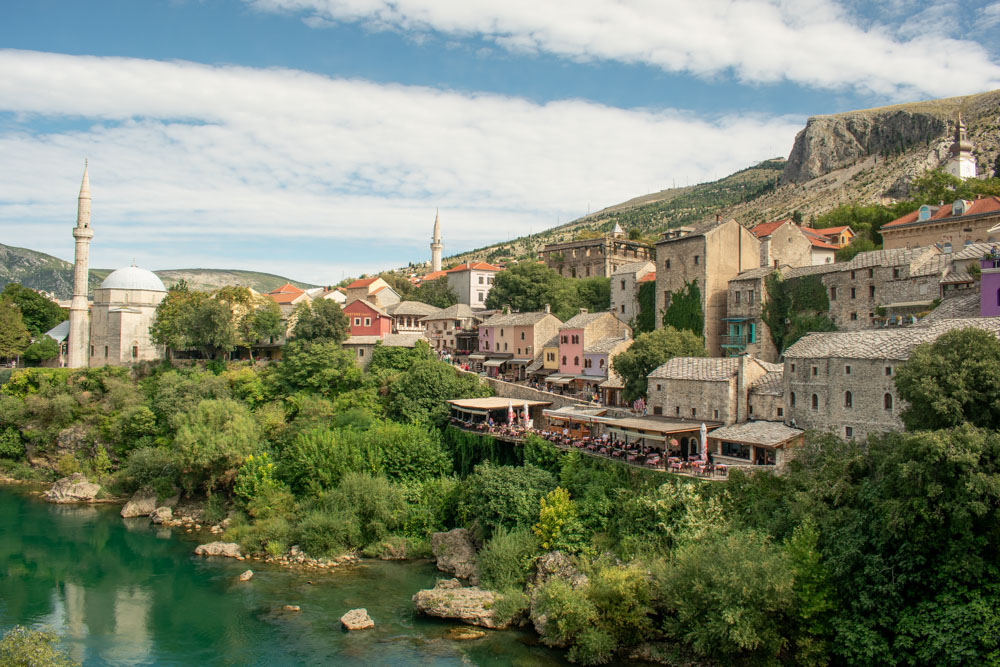
A day trip to Mostar from either Dubrovnik or Split is a very popular addition to a first time Croatia itinerary. With just one week in Croatia, it would require rushing though some other spots, which is why I don’t necessarily recommend it. But with ten days in Croatia, a day trip to Mostar fits in quite nicely.
I considered it on my first trip to Croatia, but didn’t manage due to the weather. Years later, I finally did visit Mostar and even stayed a few nights there. I wanted to make a day trip to Kravice Falls from Mostar with the extra days, but it was just too complicated via public transport. But the good news for you is that many tours to Mostar from Croatia include a stop at the falls! I unfortunately didn’t know this for my own trip, or I would have definitely opted for that.
How to Get to Mostar from Dubrovnik (and Back)
There are two ways to do a day trip to Mostar. The first is to DIY it. To do this, head to Dubrovnik’s bus terminal, which is located here. If you haven’t already purchased your ticket in advance, purchase a round trip ticket from Dubrovnik to Mostar. This will set you back around €27 each way and take a little over 3.5 hours if departing in the morning (which is pretty necessary, since it’s a day trip!).
When I did this journey from Dubrovnik to Mostar, I went to the bus terminal immediately after arriving in Dubrovnik. I asked the attendant at the kiosk for the time and price of the buses on the day I needed and purchased the ticket that worked best for me.
But if you prefer to have all your ducks in a row pre-arrival, especially if you are visiting Croatia in high season, then you may want to purchase your tickets in advance. Flixbus’ travel times do not work for a day trip, so you will want to purchase on BusBud instead.
This journey will require crossing international borders, so be sure to bring your passport.
The second way to do a day trip to Mostar is to join an organized tour. And while I typically love DIY-ing day trips, this is one of the instances where I actually recommend booking your spot on an organized tour. Why? Kravice Waterfalls.
Since Krka Park no longer allows swimming, Kravice Falls is a great way to make up for that lost opportunity to swim in a natural pool surrounded by cascading falls. And most organized tours to Mostar from Dubrovnik include a stop there!
I actually stayed multiple nights in Mostar, planning to DIY a trip to Kracive myself before continuing on to Split. But getting to the falls myself from Mostar proved less than convenient, so I didn’t make it. Had I known that tours to Mostar included a stop here, I know I would have opted for that instead of DIY-ing my trip to Mostar.
This is the tour I would recommend booking for most travelers. But for those with a bit more budget, this semi-private tour will be a nicer experience.
And if it works better for your Croatia itinerary to visit Mostar from Split instead of from Dubrovnik, this is the tour from Split with a stop at the falls that I would recommend.
What to Do in Mostar
As this day will likely be with a tour group, you won’t need to plan much, if at all! But just so you have an idea of what this day will be centered on, or if you decide to DIY it, these are the main things that you will be seeing on this day trip.
- Stari Most: The main draw in Mostar is, without a doubt, this famous bridge, whose name translates to “Old Bridge.” If you’re on social media, I’m sure you will have seen videos of brave souls diving spectacularly from the bridge down to the teal-blue Neretva River down below.
- Old Town: This is where you will find the famous bridge, which, combined with the area around it, is a UNESCO World Heritage site. So plan to take some time to stroll the stoney streets of this former Ottoman town, stopping to shop for some sweets (like Turkish Delight!) and have lunch on a lovely restaurant terrace.
- Kravice Falls: Like I mentioned above, you can swim by the waterfalls of this natural park (which you no longer are able to do in Krka, back in Croatia). Entry will set you back 20 BAM* (around €10). You can purchase entry and just learn more about the park in general at the official site.
* Pro Tip: Bosnia and Herzegovina does not use the euro! Their currency is the convertible mark (BAM). You can get by with just credit or debit card on your day trip to Mostar, and thus not need to use any BAM in cash. But it may limit you some. I wanted to buy Turkish delight from one particular shop whose display looked sooo good, but they only took cash. But other than that, I was okay during my three-night stay in Mostar.
Kotor
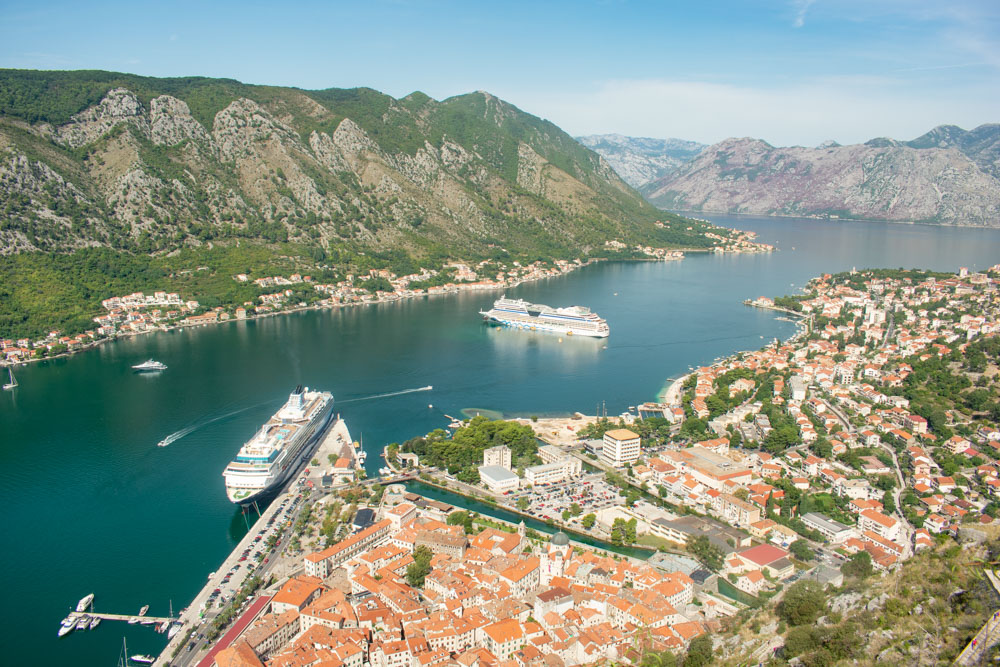
Kotor is a pretty little walled town in Montenegro, lying along a bay of its same name and nestled up against mountains. And it is a very popular day trip from Dubrovnik! I actually wanted to do this on my first visit to Croatia, but the weather sucked, making it not worth the hassle. However I finally did get to visit Kotor years later, and I can now officially report back that it’s lovely!
How to Get to Kotor from Dubrovnik (and Back)
There are two ways to do this day trip to Kotor from Dubrovnik. The first is to DIY it. To do this, head to Dubrovnik’s bus terminal, which is located here. If you haven’t already purchased your ticket in advance, purchase a round trip ticket from Dubrovnik to Kotor. This will set you back around €32 each way and take a little over 2.5 hours if departing in the morning (which is obligatory, since it’s a day trip!).
But if you prefer to have everything set up before departing for your Croatia trip, and especially if you are visiting Croatia in high season, then you might want to purchase your tickets in advance. If using FlixBus, you will need to travel on one of the days where the 7:15am bus from Dubrovnik and the 6:00pm bus from Kotor run. This would give you around 10 hours total to spend exploring Kotor and its surroundings.
This journey will require crossing international borders, so make sure you bring your passport!
The second way to do a day trip to Kotor is to join an organized tour. And while I typically love DIY-ing day trips, this is another instance where I would recommend considering an organized tour. Once again, the main reason is logistics, but also price.
Ideally, it would be nice to fit in a visit to Perast (and a boat ride to the island by it) into your day trip. So it is convenient to have the tour group manage all this transport for you, instead of having to use the local bus system or a taxi to get to Perast once you get to Kotor. And this is all before considering that the price of the tour is about €14 less than the price of just the roundtrip FlixBus tickets, without considering the extra bus or taxi to and from Perast.
So, all that to say that this is one of the rare cases where the tour ends up being cheaper than doing it yourself. I personally would suggest this tour, because it includes time in this cute little town called Perast, plus that island with the church that I’m sure you’ve seen pictures of (which is just across from Perast), in addition to Kotor. The tour also offers pickup at your accommodation, which is always convenient.
What to Do in Kotor
I stayed in Kotor for several nights, and these are the best things to enjoy while there. Luckily, you should be able to fit them all into your day trip!
- Stari Grad (Old Town): Kotor’s picturesque old town is a maze of narrow streets and terracotta-topped stoney buildings, surrounded by medieval walls (part of which you can walk on for free!). It’s a rather compact area, so you could wander all of it without planning much, if anything, in advance. And if you join a group excursion to Kotor from Dubrovnik, it should include a guided tour of this area. So you can let them take you to the couple of main attractions within the walls before heading up to the castle above.
- Sea Gate: This is the main entrance to Kotor’s old town, built back when the Venetians ruled Kotor.
- Cathedral of Saint Tryphon: Kotor has a few churches worth passing by, but this one, dedicated to their patron saint, is the oldest preserved Romanesque church in the Eastern Adriatic. It does have treasures inside, but I stuck to admiring all the old town buildings from the outside.
- Saint John’s Castle (San Giovanni Fortress): Perched high up on a mountain, this medieval fortress offers amazing views of not only Kotor’s old town, but also the entire bay. The official way up is via (over a thousand!) steps that start at the city walls. This will set you back €15 in the high season and less in other months. It took me about 30 minutes to get to the top using a round-about route called the Ladder of Kotor, instead. Once you’re up, it’s all the way back down via the steps.
- Perast: About 30 minutes north of Kotor is the cute little coastal town of Perast. I loved the swim spots here compared to those in Kotor, and it had a lot calmer of a vibe. And for those who want to visit the often-photographed islands Our Lady of the Rocks and St George, they’re just a short boat trip over from Perast. A stop and some time here is included in the tour I suggested. But for those traveling themselves, you can take the bus from this stop in Kotor. Then, to get back, wait for the same bus in Perast, on the opposite side of the road where it dropped you off coming from Kotor.
- Our Lady of the Rocks and St George: I just admired these two small islands from the shores of Perast. A visit here is also included in the tour I suggested. Otherwise, you can take a few-minute boat ride over from Perast, if you want to get up close and personal.
- Lunch recommendation: If you are traveling on a budget and looking for a quick bite rather than a full, sitdown meal while in Kotor proper, I can recommend the spot called BBQ Tanjga.
Pro Tip: Montenegro uses the euro, just like Croatia. But it is outside the Schengen area, so you will be crossing a border and will need to bring your passport (or ID, for EU peeps).
How to Get Out of Dubrovnik
Before you know it, your ten day Croatia itinerary must sadly come to an end. If you’re anything like me, you will already be planning your next trip back to Croatia to see more. But for now, you will need to make your way out of Dubrovnik city center. Dubrovnik’s international airport is called Dubrovnik Airport (DVB). You have a couple options for getting to DVB from central Dubrovnik.
- Option 1: Take a shuttle bus. From Ploče Gate, take the Platanus bus to the Dubrovnik Airport. The ride takes 30 minutes – 1 hour, if traffic is bad in summer months, and tickets for this official airport shuttle bus cost €10. You can buy the tickets in advance online from the official site. You can also purchase them in person at the main bus station in Gruž or the Platanus shuttle bus office at the lower cable car station.
- Option 2: Take a taxi. A taxi ride between central Dubrovnik and the airport should be at a fixed fare. But unfortunately this price list is not available online for me to update this guide! It is posted at the taxi information window at arrivals, so those of you landing in Dubrovnik to do this itinerary backwards can see the price there before deciding. For those doing the itinerary in my order here, last I know, it was €30 (please comment below if you have updates after your own trip!). For those of you outside the fixed fare zone, the ride will be metered and should cost €40 – €50. As with the bus, the drive takes 30 min – 1 hour in summer months.
What Foods to Eat in Croatia
I’ve given some restaurant suggestions throughout this itinerary, but what should you order once you have your menu in front of you?
- Seafood: As you all but surely will have noticed, with the exception of two day trips, this ten day Croatia itinerary is entirely along the sea. So naturally, you will have access to a lot of fresh seafood dishes on your trip!
- Truffle: Did you know that Croatia is well known for truffles? I didn’t until my first visit here! It’s true that the part of Croatia covered in this itinerary is not the one most known for them (that would be more in the north). But you can still find them in a lot of dishes, so be sure to enjoy!
- Pasta and co.: You probably noticed with some of my mentions of Venetian and Roman influences throughout this itinerary, but Croatia shares history with Italy. I really noticed this in the food, because dishes like pasta, gnocchi, and risotto were everywhere to be found.
- Burek: I saw this less in Croatia than in other Balkan countries, but burek is a flaky pastry filled with cheese and sometimes some meat, too. It’s a great option when you need something filling but don’t have time to sit down for a full meal.
- Ćevapi: These are handmade sausages, often served with fries and some veg like onion, and sometimes in a pita-like bread. You can find them in Croatia, though I believe it is more strongly associated with Bosnia and Herzegovina. So be sure to try it on your day trip to Mostar!
Adjustments to this Croatia Itinerary for 10 Days
- Starting in Dubrovnik instead of Split: You can totally do this ten day Croatia itinerary in reverse order. You may just have to then rearrange some things for Dubrovnik, depending on your flight arrival time. You might not have the energy to do all the walking that I lay out for your first day in Dubrovnik. Also, due to the ferry between Dubrovnik and Hvar taking much longer than the ferry between Split and Hvar, you’ll have a couple hours less in Hvar, too.
- Flying round-trip into Dubrovnik: I really recommend that you try to book an open-jaw or multi-city flight into Split and out of Dubrovnik if you can. But if you simply cannot get a good flight between your home airport and Split, you might choose to fly round trip into Dubrovnik. In that case, you will have to travel from Dubrovnik to Split after you land in Dubrovnik. There are of course buses, but that might be tricky to time with your flight, in case of delays with the flight or baggage claim. So I’d suggest booking a private transfer directly from DVB airport to Split, especially if you are traveling in a group and thus able to split the cost.
- Flying into Zagreb instead of Split: Since Zagreb is Croatia’s capital city, you might find a decent flight into Zagreb and out of Dubrovnik. That’s actually how I first intended this Croatia itinerary (before deciding that was too much moving hotels), so that is definitely an option. If you do that, I recommend that you spend the first night in Zagreb or immediately transfer to Plitvice Lakes (there is accommodation within the park itself!). Then, the next day take a bus to Plitvice (or just wake up there if you made the transfer right after your flight). There is luggage storage at the park entrance for you. After enjoying Plitvice, hop on a bus from Plitvice to Split, where you will spend night two. Then follow the rest of this itinerary more or less as is, obviously skipping the day trip to Plitvice/Krka day, but exploring Split, then Hvar, then Dubrovnik.
- Flight into Zadar instead of Split: In the words of Alfred Hitchock, “Zadar has the most beautiful sunset in the world.” And if you are already in Europe, you might find a good flight into Zadar, like I did on my first visit to Croatia. Zadar is the closest to Plitvice of any cities mentioned in this guide. So with that, plus its renowned sunsets, it’s a great option to fly into if you don’t mind changing hotels one more time versus what I have in this itinerary. So if you fly into Zadar, explore the cute, seaside city day one. Then, make a round trip day trip to Plitvice from Zadar – just under 2 hours each way. On morning three, take the bus to Split (a little under 2.5 hours), and follow the rest of this itinerary more or less as is, obviously skipping the day trip to Plitvice/Krka day, but exploring Split, then Hvar, then Dubrovnik.
- Staying on Korčula instead of Hvar: Another beautiful and popular island is Korcula. It has the absolute clearest waters I have ever seen – even better than the waters in Hvar! If you want something quieter than Hvar, or you don’t care for the island hopping tour (how?!), then consider staying on Korcula instead. This would also split up the ferry journeys between Split and Dubrovnik more evenly, since Hvar and then Korcula are both on the way from Split to Dubrovnik. So you get a later wake up call on the morning that you travel to Dubrovnik. If you choose to stay on Korcula, you would travel from Split to Korcula instead of from Split to Hvar. Make sure your ferry goes to Korčula the town (which is also the name of the island) and not Vela Luka, which is on the complete other side of the island. On that day, you could explore Korcula. Then, on your second day, you could make a day trip to Hvar via ferry.
- Visiting Trogir and the Blue Lagoon instead of Plitvice or Krka: If you don’t feel like making the long trek from Split to Plitvice, but aren’t in love with the idea of replacing Plitvice with Krka (maybe you know you can return to Croatia later and plan to visit Plitvice then), consider replacing that day trip with a day in Trogir and its famous Blue Lagoon (different from the Blue Lagoon on the island hopping day from Hvar!). This tour’s afternoon option is perfect, because you get to not only sleep in, but you’ll be ending your tour around sunset!
- Only doing one cross-border day trip instead of two: If you must choose between the day trip to Mostar and the day trip to Kotor, I personally recommend Mostar. The touristy things to do and see in Mostar take up less time than those in Kotor. So you will feel less rushed. Also, I have crossed the Bosnia and Herzegovina – Croatia border four times total now. And the roads had way less traffic than the one connecting Montenegro and Croatia, meaning border control was not backed up. So for all those reasons, the Mostar day trip seems much more doable to me than one to Kotor. I also think Mostar provides more of a contrast to Croatia, due to its Ottoman history (and thus architecture). Coastal Montenegro, on the other hand, has a similar architectural look to coastal Croatia. So all that to say, I personally would recommend a day trip to Mostar and Kravice Falls over a day trip to Kotor, if you only can choose one. And again, you can visit Mostar from Split or visit Mostar from Dubrovnik.
Questions on My 10 Day Croatia Itinerary?
Phew! I know that was a loooooot of info! What do you think of my Croatia ten day itinerary for first timers? If you’re planning your own trip to Croatia soon and want some personalized advice, drop a comment below with your questions. I love playing travel agent for people – especially for countries that I love, like Croatia!
And in Case You Need One Last Summary
You are free to rearrange the day trips from a base as you’d like. And remember that you can visit Mostar from Dubrovnik or visit Mostar from Split. The only thing I’d particularly recommend is to consider avoiding a day trip on your final day if you can, so that you don’t have to stress on your last evening (in case you get traffic at the border crossing back from Mostar or Kotor).
Croatia Ten Day Itinerary:
- Day 1: Split
- Day 2: Split
- Day 3: Plitvice Lakes, or Krka (day trip)
- Day 4: Hvar
- Day 5: Island hopping day (day trip)
- Day 6: Korcula (day trip)
- Day 7: Dubrovnik
- Day 8: Mostar (day trip)
- Day 9: Kotor (day trip)
- Day 10: Dubrovnik
Save this Ten Day Croatia Itinerary on Pinterest

You should visit Istria next, it is the heart and stomach of Croatia. 😉
Rovinj, Poreč, Umag, Piran and Trieste are on top of everyone’s lists.
Best gastronomy, top beaches, amazing wine country, hillside towns and villages like Motovun and Grožnjan. You will love it.
I’m glad you are providing the information. But I could not make it past the language section. It refreshes every time and brings me back to the top. The ads are making the experience unreadable. Thanks for writing all this up though.
Hi,
Thanks for the feedback! I will look into fixing that!
– Em
My husband and I will be renting a car for our upcoming trip to Croatia and would be using car ferries between the islands we decide to visit. I struggle with motion sickness and although I will be taking meds and using patches to ward off motion sickness I am concerned about ferry trips. I know the weather will impact the seas but wondering if you have any thoughts on the likelihood of having issues with motion sickness on a car ferry if the weather is not stormy. We will be in Croatia mid-September to early October. I have read lot of travel blogs and forums online but I don’t see motion sickness as an issue that get discussed.. So maybe on non-stormy days the seas are mostly calm and this is not a problem. I would appreciate your thoughts.
Hi D,
In my own experience, I’ve only had bumpy boat rides in Croatia on the smaller ferries (like the catamaran ferries) and never on the larger, car-carrying ferries. So I think you should be ok, but I’m of course no sea expert! Also, it’s the sea conditions that determine if a ride will be bumpy, not necessarily the sky conditions (so the sky can look great but the sea can still be choppy). Again, I think you should be fine on the car-carrying ferries though.
Hope that helps!
– Em
Olá, viajante. Pretendo ficar uns 9 dias na Croácia a partir de 20 de maio deste ano. Será que já é possível curtir praia ou o clima ainda é muito instável e águas bem geladas? Eu já fui uma vez à Grécia mais ou menos no mesmo período e consegui aproveitar bastante praia, mas estou insegura quanto à Croácia,
Hi Stella,
My first trip to Croatia was in mid-May, and about half the trip was nice weather while the other half was rainy. So you unfortunately never know! On the days that it was sunny, the sea was warm enough to swim in for me. But I would not have wanted to swim in it on the cloudy days.
Croatia is a bit higher north than Greece, so the water should be a bit cooler.
Hope that helps!
– Em
Is een combinatie van fietsen en een dagje met een auto (huren) mogelijk? En te doen?
Hi Jan,
I know that this exact itinerary can be done with a car, but I unfortunately can’t speak to cycling at all. I haven’t met anyone doing that yet in my visits to Croatia.
Sorry to not be of more help!
– Em